
To anyone outside the factory, one hollow core slab looks much like another. Inside a precast concrete operation, that resemblance is misleading — and it is exactly where most ERP implementations come undone.
We recently worked with a precast concrete manufacturer producing eight product lines: hollow core slabs, retaining walls, solid slabs, staircases, precast walls and columns, among others. The challenge wasn’t the number of products. It was that no two units are truly the same.
The problem: a different bill of materials for every unit
Take a single product line — hollow core slabs. Change the length, the depth, or the floor the piece will sit on, and the material mix changes with it. Crucially, it does not change as a fixed ratio you can scale up or down. Each slab is calculated on its own, so each slab needs its own bill of materials.
Now multiply that across all eight product lines, and across the materials underneath each one: steel reinforcement rods in multiple thicknesses (8mm, 10mm, 12mm, 16mm, 25mm and more, often several sizes within a single unit), cement, M-sand, water, and three different grades of aggregate. The number of distinct bills of material is enormous, and a standard “one product, one BOM” setup simply cannot represent it.
Why this breaks standard ERP setups
Most ERP templates assume a product has a stable recipe. Precast doesn’t work that way. Treating every dimensional variant as a separate product is unmanageable; forcing an average “standard” ratio quietly destroys cost accuracy and leads to over- or under-purchasing on every project. The business needs the structure of an ERP without losing the reality that every unit is bespoke.
What we built in Odoo
Odoo’s manufacturing module is flexible enough to model genuinely discrete bills of material — if it is designed correctly. For this client we built three things:
- A discrete, configurable BOM structure in which every individual unit carries its own material recipe, with no forced standard ratios.
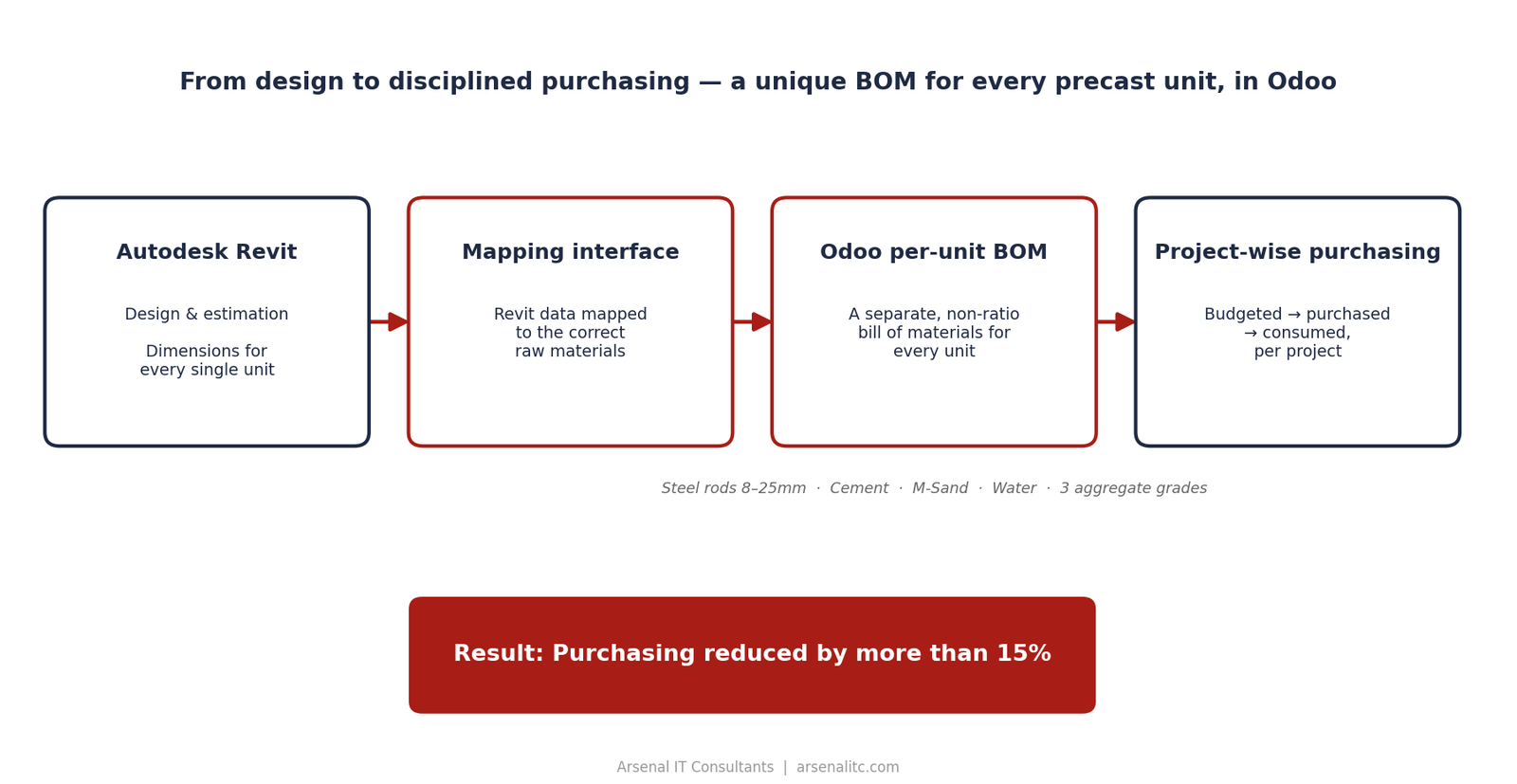
- An interface to Autodesk Revit, the client’s design and estimation software, that maps the design data for each unit directly to the correct raw materials in Odoo.
- Project-wise budgeting and consumption, so the exact quantities required are budgeted, purchased and consumed against each individual project rather than against a vague aggregate.
The result
With accurate calculations flowing from design straight through to procurement, and proper controls in place, the client reduced purchasing by more than 15%. That saving came entirely from buying the right quantities of the right materials for each project — not from squeezing suppliers.
The takeaway
Complexity isn’t the enemy of an ERP; vague processes are. If you can describe how a product is built — however bespoke, however discrete — it can be modelled. The expertise lies in the design of the bill of materials and the controls around it, not in pretending the products are simpler than they are.
Arsenal IT Consultants implements Odoo ERP for manufacturers with genuinely complex, discrete bills of material. Get in touch to discuss your operation, or read more about our Odoo implementation expertise.